
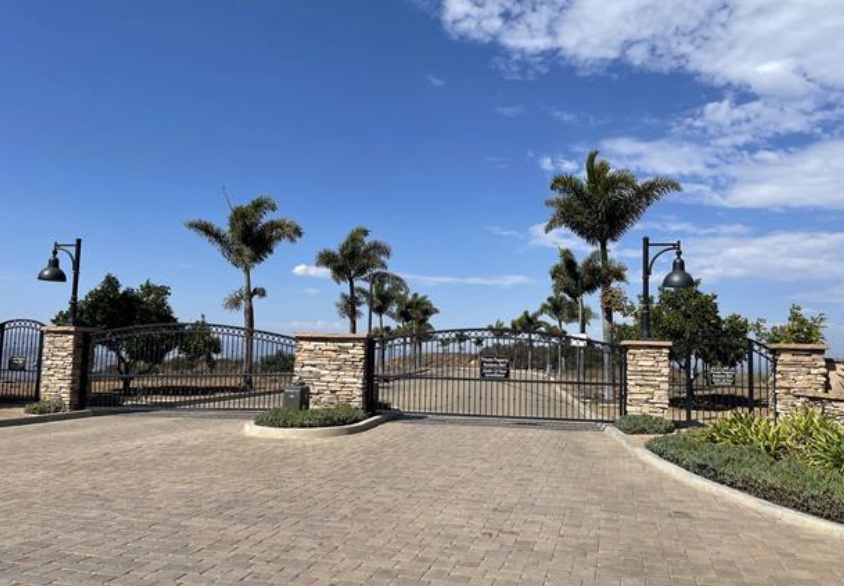
How criminals used stolen identities to target North County properties — and why most homeowners don’t know about the free county tools that can help protect them.
Important Note
I am an associate real estate broker, not a fraud expert, attorney, or law enforcement professional. This article shares my personal experience encountering fraud attempts and summarizes information from authoritative sources such as the FBI, National Association of REALTORS®, California Department of Real Estate, and local attorneys. I did not “stop” these crimes—I encountered suspicious circumstances, followed industry guidance, and notified the appropriate parties. For advice specific to your situation, please consult with your attorney, law enforcement, or qualified security professionals.
Real Estate Fraud in San Diego: How My Experience Began
I never expected to encounter real estate fraud in San Diego County—but over the past nine months, that’s exactly what happened. What began as a normal listing opportunity turned into a series of sophisticated seller-impersonation scams that opened my eyes to how widespread this problem has become in North County.
I’m an associate real estate broker, not a fraud expert, but after personally discovering three separate attempts, I realized most property owners have no idea how vulnerable vacant land and out-of-state holdings can be, or that free county systems exist to help them protect their properties.
The Vista View Lot: When Everything Looked Legitimate
The “sellers” were thorough. We spent weeks negotiating pricing and reviewing comps, just like any legitimate listing. They asked thoughtful questions, reviewed my marketing plan, and behaved like true out-of-state owners preparing to sell.
There were no red flags, no inconsistencies, nothing that suggested this wasn’t legitimate. So I listed it.
Why Nothing Looked Suspicious at First
When I researched the property, I saw it had been listed previously and showed in the MLS as an expired listing. Several other lots in the same gated community were also for sale and had been sitting on the market for a long time, so nothing about the MLS history or market context looked unusual. Everything aligned with what I’ve seen many times over the years, and the fraudulent “seller” communication appeared completely legitimate.
When Things Quickly Became Strange
Within hours of the listing going live, calls and emails started coming in steadily from buyers and agents. That part wasn’t unusual—effective marketing attracts attention—but given the surrounding lots had been slow to move, the volume stood out.
When I went to take preliminary photos, the “sellers” couldn’t provide the gate code. They told me to ask a security guard who didn’t exist. That was my turning point.
I contacted the prior listing agent, the one who had represented the property during its earlier listing. later told me the people she dealt with had not been the real property owners. That confirmed my suspicion: the identity theft had started long before my involvement.
Multiple Attempts on the Same Property — All Within About a Year
As I dug deeper into the history of the Vista lot, it became clear that the scammers didn’t just try once. The same legitimate property owners were targeted three separate times within roughly a one-year period.
Attempt #1: The First Listing
The lot had been listed by a different agent earlier that year and eventually showed as an expired listing. When I later spoke with that agent, she told me the people she dealt with were not the real owners—the first known impersonation attempt.
Attempt #2: My Listing
Months later, the scammers contacted me using the same identities. Everything appeared legitimate—ownership records, addresses, and IDs all matched. I listed the property, discovered inconsistencies shortly after, and my brokerage cancelled the listing immediately.
Attempt #3: Another Agent in My Office
A few months after my experience, another agent in my office contacted me. He said the same “sellers” had reached out to him multiple times about listing the identical Vista lot. When he checked the MLS and saw both the expired listing and my cancelled listing, he called me for clarification. That was the third attempt on the same legitimate property owners.
A Separate Case: A Different North County Parcel — and This One Reached Escrow
Around this same time, I was contacted by “out-of-state sellers” about listing another parcel in North County. When I researched it, I learned that property had also been targeted in a seller-impersonation scam.
I spoke with the listing agent who had actually handled it. She told me the scammers had impersonated the real owners, passed early verification, secured a legitimate buyer, and the property went into open escrow. The fraudulent “sellers” were pushing for a quick closing. The real owner eventually discovered the situation and stopped the sale in time.
This case came dangerously close to completing.
A Buyer’s Misconception — and Why It’s Dangerous
One interested buyer tried to view the Vista lot on his own before I could warn him. A neighbor told him, “Agents list properties just to get leads.”
That misconception is dangerous—and completely false.
A licensed real estate agent cannot and would not list a property without the seller’s consent. Doing so is a severe violation of real estate law and could result in immediate license suspension or revocation. In this case, the listing wasn’t a tactic. It was real estate fraud in San Diego, and the scammers were impersonating actual property owners.
Real Estate Fraud in San Diego County: A National and Regional Crisis
What I experienced mirrors what federal and state agencies are now reporting: seller impersonation attempts are increasing, vacant land is a primary target, forged IDs are becoming more sophisticated, and recovery is often difficult once money moves. This isn’t a small or isolated issue—it’s a rapidly growing national problem.
The National Picture: FBI Statistics
According to the FBI and industry reports:
📊 500% increase in property deed fraud schemes in recent years
📊 $400 million lost annually to real estate-related fraud in the United States
📊 Only 18% of stolen funds are ever recovered
📊 Only 3% of reported cases result in prosecution
📊 54% of real estate professionals experienced at least one seller impersonation fraud attempt within six months (CertifID, 2023)
The Secret Service Cybercrime Unit issued an advisory warning in 2023 about seller impersonation fraud—and the alerts are still sounding.
The Graceland Attempt: Even High-Profile Properties Are Targeted
The most high-profile property fraud case? A Missouri woman was arrested for allegedly attempting to sell Graceland—Elvis Presley’s famous estate—in a multimillion-dollar fraud scheme that was stopped just hours before auction.
If criminals are bold enough to target Graceland, any vacant lot in Vista, Fallbrook, or Oceanside is absolutely on their radar.
SDAR Confirms: Multiple San Diego Agents Targeted by Same Scam
In November 2025, the San Diego Association of REALTORS® issued a public alert after multiple REALTORS® across different regions of San Diego County were contacted by the same impersonator.
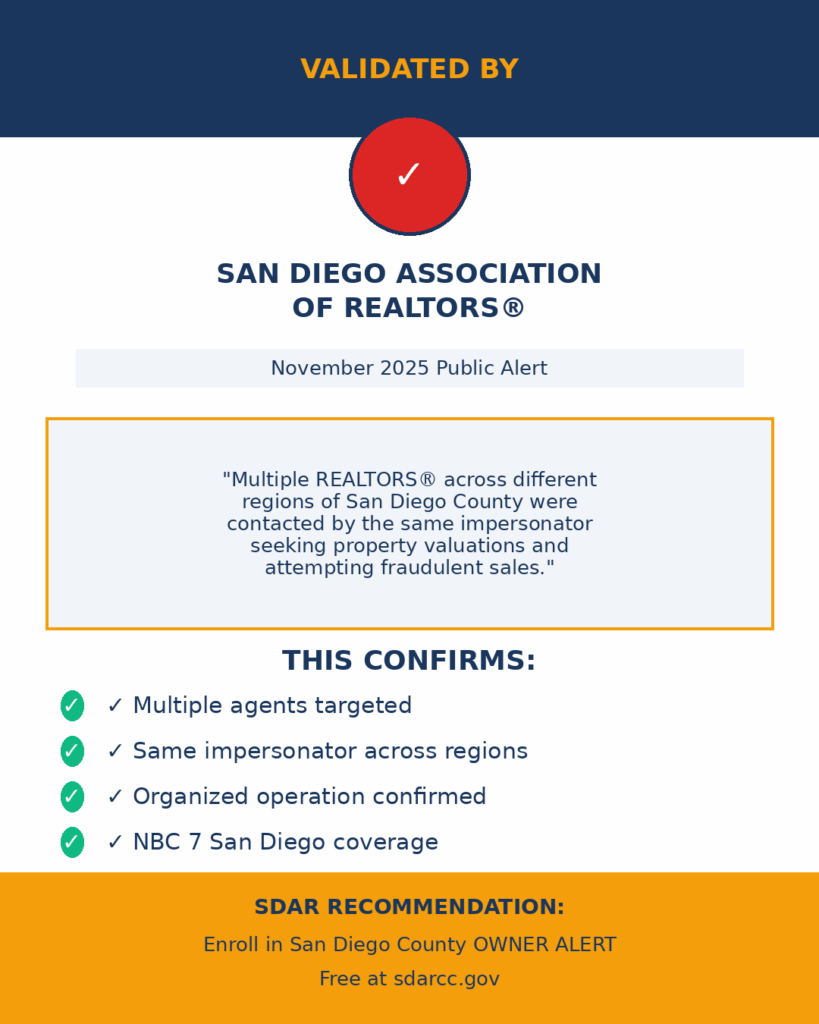
According to the SDAR alert, the scheme involved criminals posing as homeowners to obtain property valuations and attempt fraudulent sales—exactly what I encountered with the Vista property and the other North County parcel.
NBC 7 San Diego covered the story in an interview with SDAR President Chris Anderson and San Diego County Tax Assessor Jordan Marks, confirming this is an organized, regional operation targeting real estate professionals throughout San Diego County.
Read the SDAR Alert: https://www.sdar.com/news/san-diego-real-estate-scam-alert.html
The same recommendations from SDAR? Enroll in San Diego County’s OWNER ALERT system at https://sdarcc.gov
This validates everything I experienced:
- ✅ Multiple agents targeted (not just me)
- ✅ Same impersonators across regions (organized operation)
- ✅ Professional approach (property valuations, not obvious scams)
- ✅ SDAR recommends OWNER ALERT (same as FBI and local attorneys)
My encounters happened months before this public alert. When agents don’t share their experiences, criminals continue operating undetected. This is why I’m speaking out.
Why Standard Verification Isn’t Always Enough
Like many agents, I followed all standard professional steps:
- Checking county ownership records
- Obtaining a title profile
- Verifying matching names and addresses
- Reviewing IDs
- Spending weeks in communication
Everything matched perfectly on paper. That’s the danger—modern fraud can pass the early checks.
Think about how credit card identity theft works. Someone steals your identity and opens a credit card. The bank verifies name, Social Security number, address, credit history. The bank approves the card. Did the bank fail? No—they were fooled by sophisticated identity theft.
That’s exactly what happened with this property fraud scheme.
The Most Important Protection: Monitoring, Not Guesswork
Real estate fraud in San Diego cases often succeed because property owners are not watching their recorded documents. Fortunately, San Diego County offers a free tool that helps protect against fraudulent recordings:
San Diego County OWNER ALERT Program (Free)
Enrollment: https://www.sdarcc.gov/owneralert
OWNER ALERT notifies you whenever anything is recorded against your property—deeds, liens, title changes, or other activity. It does not prevent fraud, but it alerts you the moment something happens so you can respond quickly.
Think of it like identity theft monitoring: It doesn’t prevent criminals from trying to steal your identity—but it alerts you when something happens so you can act quickly. The faster you know, the faster you can report it to authorities and minimize damage.
How to Enroll:
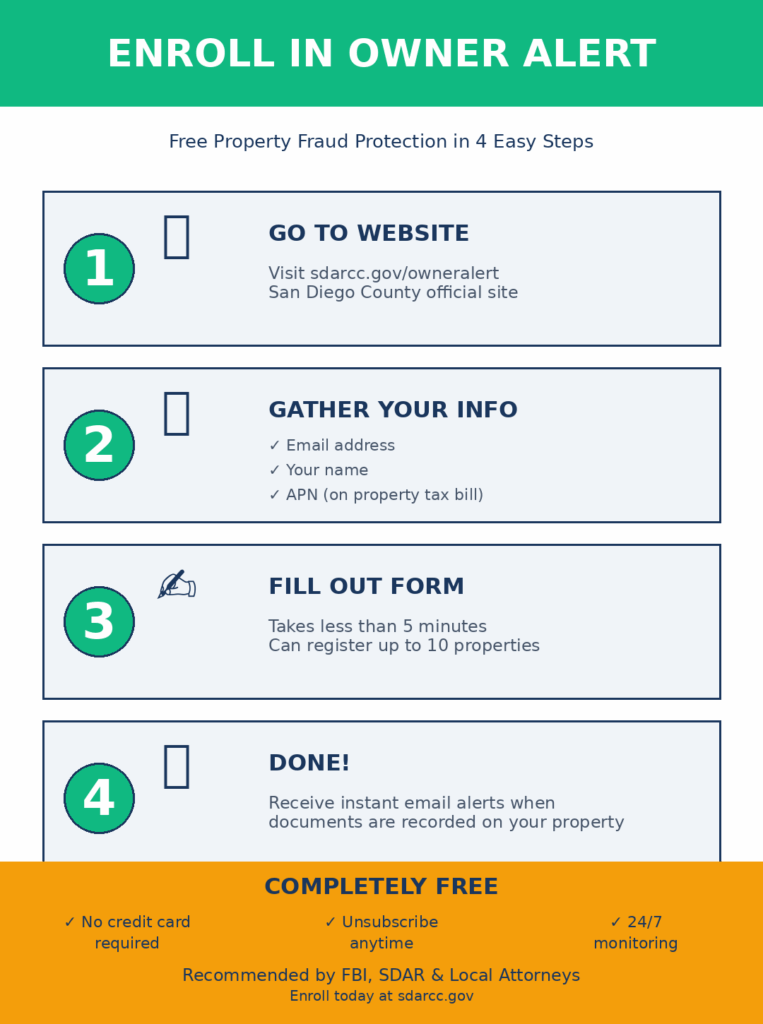
- Go to https://sdarcc.gov
- Find your APN (Assessor Parcel Number) – it’s on your property tax bill or at https://assr.parcelquest.com/Home
- Enter your name, email, and APN
- Done—you’ll receive instant alerts
Important details:
- Completely free
- Can register up to 10 properties per email
- Applies to documents recorded AFTER you enroll
- You can unsubscribe anytime
It is especially important for owners of:
- Vacant land
- Out-of-state holdings
- Inherited properties
- Investment properties
- High-equity properties
- Trust and probate properties
Who Is Most at Risk for Real Estate Fraud in San Diego County?
Criminals most often target:
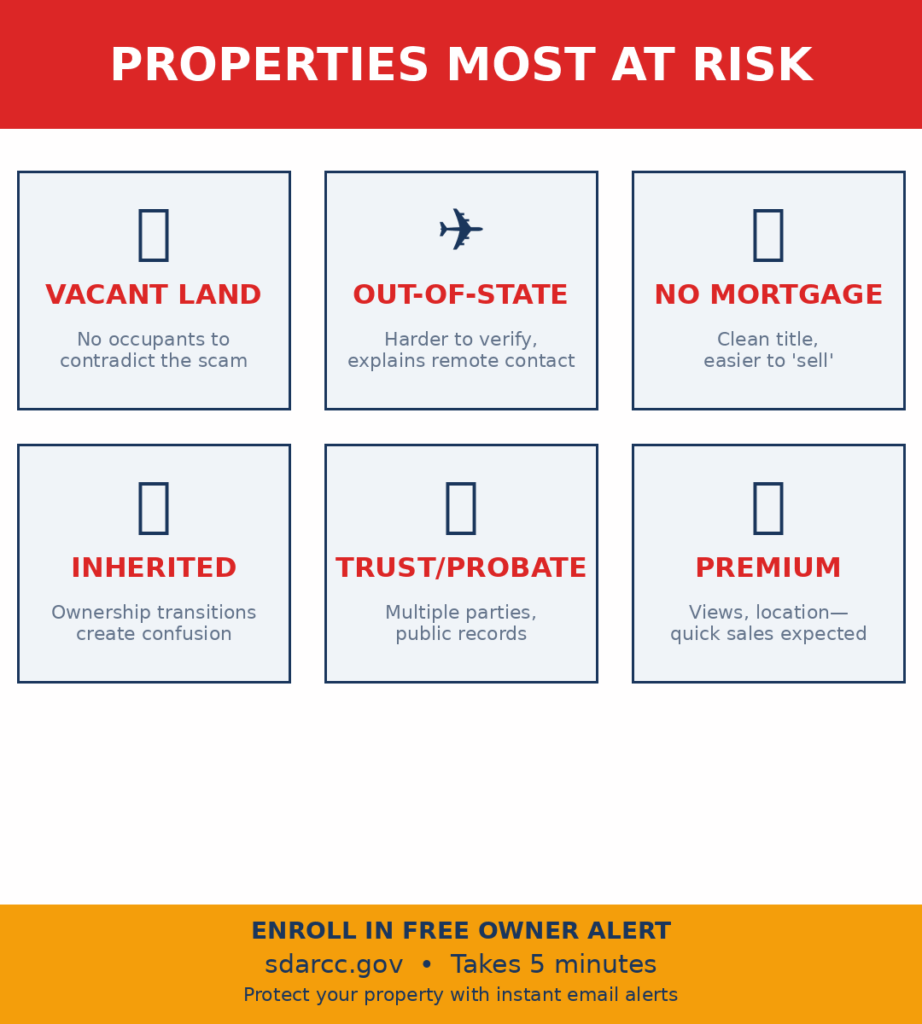
🎯 Vacant lots (no occupants to contradict the scam)
🎯 Out-of-state owners (harder to verify, explains remote communication)
🎯 Properties owned free and clear (clean title, easier to “sell”)
🎯 Properties with recent ownership changes (ownership transitions create confusion)
🎯 Trust and probate properties (multiple parties, public records)
These were exactly the types of properties involved in the cases I encountered.
Why Probate and Trust Properties Are Vulnerable
As a Certified Probate & Trust Specialist, I’ve seen how inherited properties become fraud targets during transitions:
- Heirs may not monitor the property closely during probate
- Property ownership is in flux and publicly recorded
- Multiple parties involved can create confusion
- Criminals monitor probate records for vulnerable properties
If you’re managing a trust or estate property, enrolling in OWNER ALERT is critical—especially during the transition period when ownership changes are being recorded.
Red Flags for Property Fraud
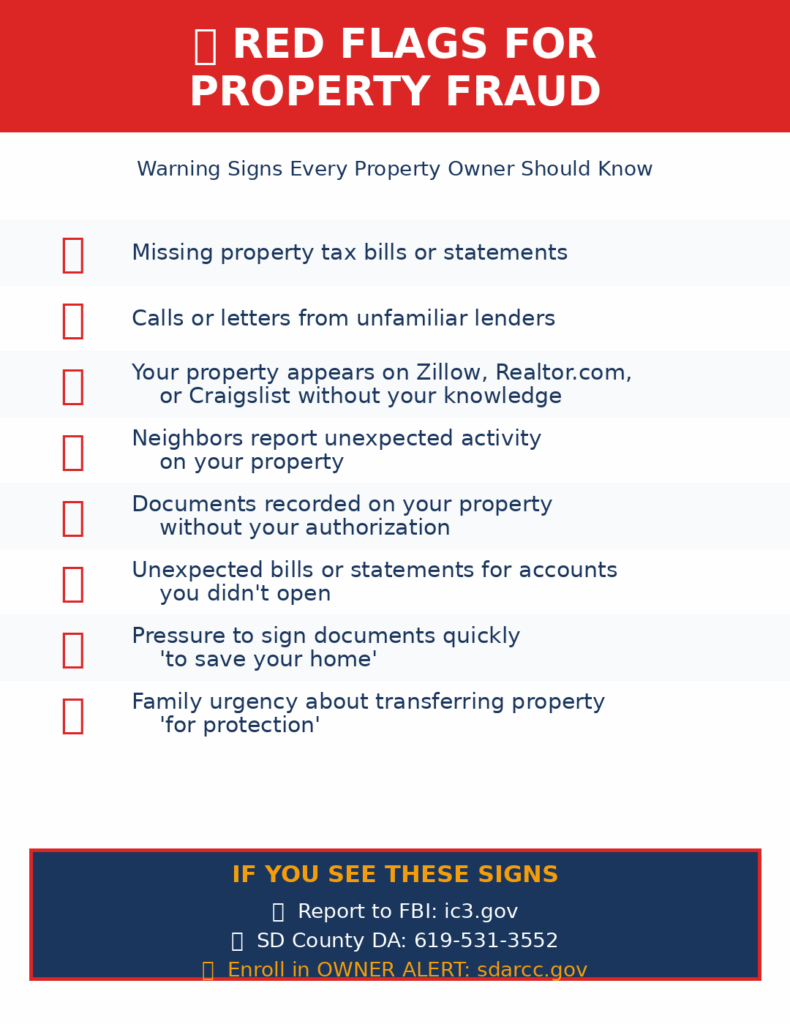
🚩 Missing property tax bills or statements
🚩 Calls or letters from unfamiliar lenders
🚩 Online listings you didn’t authorize
🚩 Neighbors reporting unexpected activity
🚩 Documents recorded without your knowledge
🚩 Unexpected bills or statements for accounts you didn’t open
🚩 Pressure to sign documents quickly “to save your home”
🚩 Family urgency about transferring property “for protection”
Wire Fraud: The Other Major Threat to Real Estate Transactions
While my experience involved property fraud (criminals impersonating sellers), wire fraud is actually the most common cybercrime in real estate.
The National Wire Fraud Crisis
According to the National Association of REALTORS®:
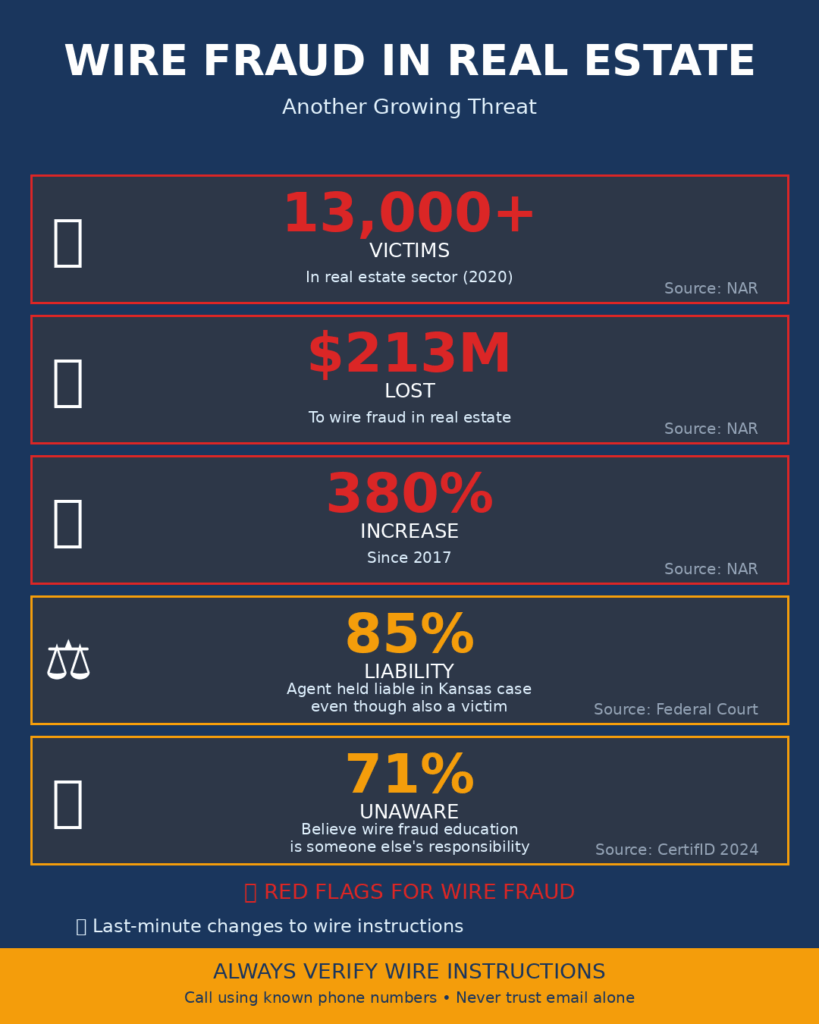
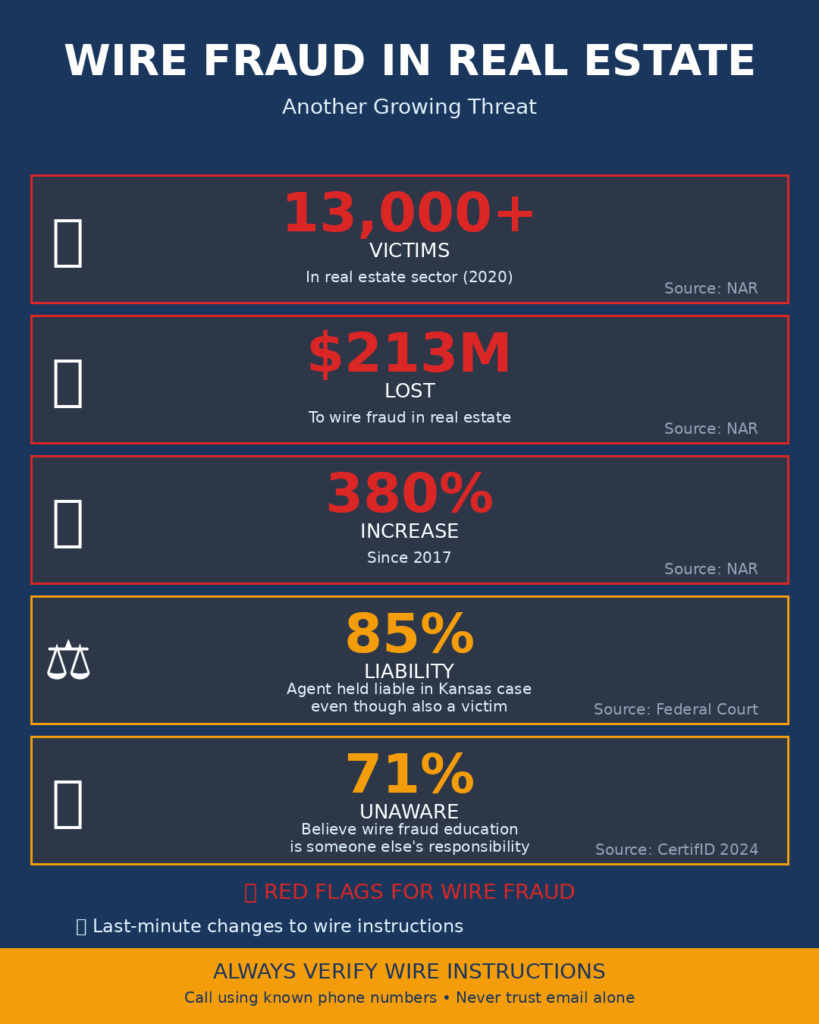
📊 More than 13,000 people were victims of wire fraud in the real estate and rental sector in 2020, with losses of more than $213 million—an increase of 380% since 2017
📊 71% of consumers believe it’s someone else’s responsibility to teach them about wire fraud (CertifID 2024)
📊 FBI reports $12.5 billion in victim losses from all cybercrime in 2023
How Wire Fraud Works in Real Estate
The typical scheme:
- You’re in a legitimate real estate transaction (buying or selling)
- Criminals hack or spoof emails from your agent, title company, or lender
- You receive what looks like legitimate wire instructions
- You wire your down payment or proceeds to the criminal’s account
- By the time you discover it, the money is gone—often overseas
Why Agents Can Be Held Liable
This is important: Even if an agent is also a victim of wire fraud, they can still be held responsible.
In a Kansas case, a federal court upheld a jury verdict finding a real estate licensee 85% responsible for a buyer’s losses when the buyer transferred money to a fake account after the licensee allegedly forwarded an email containing fake wiring instructions to the buyer.
This is why I’m careful about wire fraud warnings with every client—it’s not just about protecting you, it’s a legal responsibility.
My Wire Fraud Prevention Protocol
In every transaction, I follow strict procedures based on NAR best practices and legal guidance:
Before Closing: ✅ Provide wire fraud education at our first meeting
✅ Never send wire instructions via email alone
✅ Establish verified phone numbers for all parties upfront
✅ Warn about “last-minute change” schemes
When Wire Instructions Are Needed: ✅ Instructions come from title company through secure portal when possible
✅ Client must call title company using pre-verified phone number to confirm
✅ Verify EVERY digit of account and routing numbers verbally
✅ Never trust phone numbers included in emails
Red Flags for Wire Fraud: 🚩 Last-minute changes to wire instructions
🚩 Emails with slight misspellings in sender addresses
🚩 Urgent pressure to wire immediately
🚩 Instructions to wire to individual accounts vs. escrow accounts
🚩 Requests to wire to foreign banks
Fraudsters often impersonate lenders, title companies, or agents using spoofed emails. Careful verification is critical.
Why I’m Sharing This
I’m not a fraud investigator. I’m a real estate professional who personally encountered multiple fraud attempts, saw similar situations arise with other agents, and realized many owners simply don’t know about the free protection tools available to them.
After my encounters with property fraud in North County San Diego:
- Agents from my office now call me when something feels off
- Our Temecula office agents shared similar experiences
- SDAR confirmed months later that multiple agents across the region were targeted
- I’ve become an informal resource for fraud awareness
The FBI reports a 500% increase in property fraud schemes. The Secret Service issued warnings. SDAR issued a public alert. This isn’t stopping—it’s accelerating.
Real estate fraud in San Diego County is increasing, and awareness is one of the best defenses we have. The more property owners who enroll in county alert systems, the harder we make it for criminals to operate in our community.
Take Action: Protect Your Property
1. Enroll in OWNER ALERT (Free – Takes 5 Minutes)
2. Basic Monitoring (Also Free)
- Occasionally search your property online on Zillow, Realtor.com, Redfin, and Craigslist for unauthorized activity
- Use Google Alerts for your property address
- Check credit reports at AnnualCreditReport.com for unexpected HELOCs or loans
- Monitor your mail for property-related correspondence
3. If You Suspect Fraud, Contact:
- San Diego County District Attorney Real Estate Fraud Unit: 619-531-3552 / [email protected]
- FBI Internet Crime Complaint Center (IC3): https://www.ic3.gov/
- Better Business Bureau Scam Tracker: https://www.bbb.org/scamtracker
- Local law enforcement (file police report)
- Your attorney
DO NOT contact the suspected scammer—this can alert them to hide evidence.
My Role and Commitment
After encountering three property fraud attempts over nine months, here’s what I can offer:
What I Can Do:
- Share my personal experience with fraud attempts
- Point you to official resources from FBI, NAR, California DRE, SDAR, and local authorities
- Help you navigate the free SD County OWNER ALERT enrollment process
- Maintain awareness of warning signs based on industry guidance
- Report suspicious activity to appropriate authorities
What I Cannot Do:
- Guarantee detection of fraud (these schemes fool professionals)
- Authenticate documents or IDs (not my training or legal authority)
- Provide legal, security, or investigative services (consult appropriate professionals)
- Promise any transaction is fraud-free (criminals are sophisticated)
- Act as law enforcement or fraud expert (I’m a real estate broker)
My Role: I share what I experienced, point you to authorities and official resources, and help connect you with free protection systems. The FBI, local attorneys, county officials, and SDAR recommend these protections—I’m simply making sure North County property owners know they exist.
Additional Resources for Property Fraud Prevention
Report Fraud:
- FBI IC3: https://www.ic3.gov/
- SD County DA Real Estate Fraud Unit: 619-531-3552 / [email protected]
- Better Business Bureau Scam Tracker: https://www.bbb.org/scamtracker
Industry Information:
- San Diego Association of REALTORS® Scam Alert: https://www.sdar.com/news/san-diego-real-estate-scam-alert.html
- NBC 7 San Diego Coverage: https://www.nbcsandiego.com/video/videos/san-diego-realtor-targeted-in-elaborate-real-estate-scam/3934855/
- National Association of REALTORS® Wire Fraud Resources: https://www.nar.realtor/wire-fraud
- California Department of Real Estate: https://www.dre.ca.gov/
- Coalition to Stop Real Estate Wire Fraud: https://stopwirefraud.org/
-
Legal Guidance:
- Geiger Law Office (Carlsbad): https://www.geigerlawoffice.com/ | 760-448-2220
Elder Fraud Resources:
- San Diego County Adult Protective Services: 1-800-510-2020
- California Department of Aging: https://www.aging.ca.gov/
Contact
Sharon Corcoran
Real Estate Broker Associate | HomeSmart Realty West
Three Decades Serving North County San Diego
📞 Phone: 760-522-1972
📧 Email: [email protected]
🌐 Website: www.sharoncorcoran.com
Certified Probate & Trust Specialist | Military Relocation Professional | former Certified Property Manager
This article shares my personal experience with property fraud attempts in North County San Diego and compiles information from authoritative sources. I am not an attorney, fraud expert, or law enforcement professional, and this is not legal advice. For legal guidance specific to your situation, consult with a qualified attorney. For fraud reporting and investigation, contact appropriate law enforcement agencies.
OWNER ALERT is a notification system, not a prevention or guarantee system. It alerts you when documents are recorded—it does not prevent fraud, authenticate documents, or guarantee early detection. Like credit monitoring for identity theft, it’s one important tool in a comprehensive protection strategy.
© 2025 Sharon Corcoran. All rights reserved.
This article may be shared with proper attribution and a link back to the original source. Reproduction or republication without permission is prohibited and may constitute copyright infringement.
To request permission to republish, please contact [email protected].